
Touchless Faucet Sensor Failure Review: False Activations, Slow Response & Detection Problems Compared
When a commercial touchless faucet misbehaves, the sensor is often blamed first. In reality, unreliable activation can result from detection geometry, reflective surfaces, improper range settings, lighting conditions, basin placement, dirty sensor surfaces or control logic. This review compares sensor architectures through the problems facility teams actually encounter.
Five Common Sensor Complaints
False Activation
Water starts even though the user’s hands are outside the intended washing zone.
Slow Response
The user repeatedly moves their hands before sensing and water delivery begin.
Missed Detection
Sensor geometry fails to recognize hands consistently within the expected zone.
Continuous Run
An object remains detected or control logic fails to end the activation cycle.
Different Basin Behavior
The same faucet performs differently when basin depth, color or reflectivity changes.
Commissioning Drift
A range suitable during installation becomes problematic after surrounding finishes change.
Sensor Problem or Installation Problem?
| Symptom | Possible Cause | First Engineering Check |
|---|---|---|
| Ghost activation | Reflection or oversized detection zone | Check sensing distance and basin reflection. |
| Delayed activation | Weak detection geometry | Confirm intended hand position relative to sensor. |
| Random shutoff | Hands moving outside detection zone | Review sensing envelope rather than valve first. |
| Continuous water | Persistent detection or control fault | Remove objects from sensing zone and verify timeout. |
| Works at one sink only | Basin or countertop interaction | Compare material, depth and faucet position. |
Fontana Aeris SenseFlow Brushed Gold Aura Touchless Faucet

Fontana Aeris SenseFlow Brushed Gold Aura Touchless Faucet
The Fontana Aeris SenseFlow is a useful example of a specification-driven commercial sensor faucet where predictable activation and commissioning consistency are paired with a finish suitable for premium commercial interiors.
Fontana’s current product resources describe the series around stable sensor response and repeated commercial installations. That makes it particularly relevant where architects want a high-end visible fixture without sacrificing predictable no-touch operation.
Good fit for repeated sink-bank installations requiring consistent activation.
Final sensor commissioning still needs coordination with the selected basin.
Best fit: Luxury hotels, premium offices, aviation lounges and upscale public restrooms.
Review Fontana Aeris SenseFlow →American Standard NextGen Selectronic® Touchless Faucet
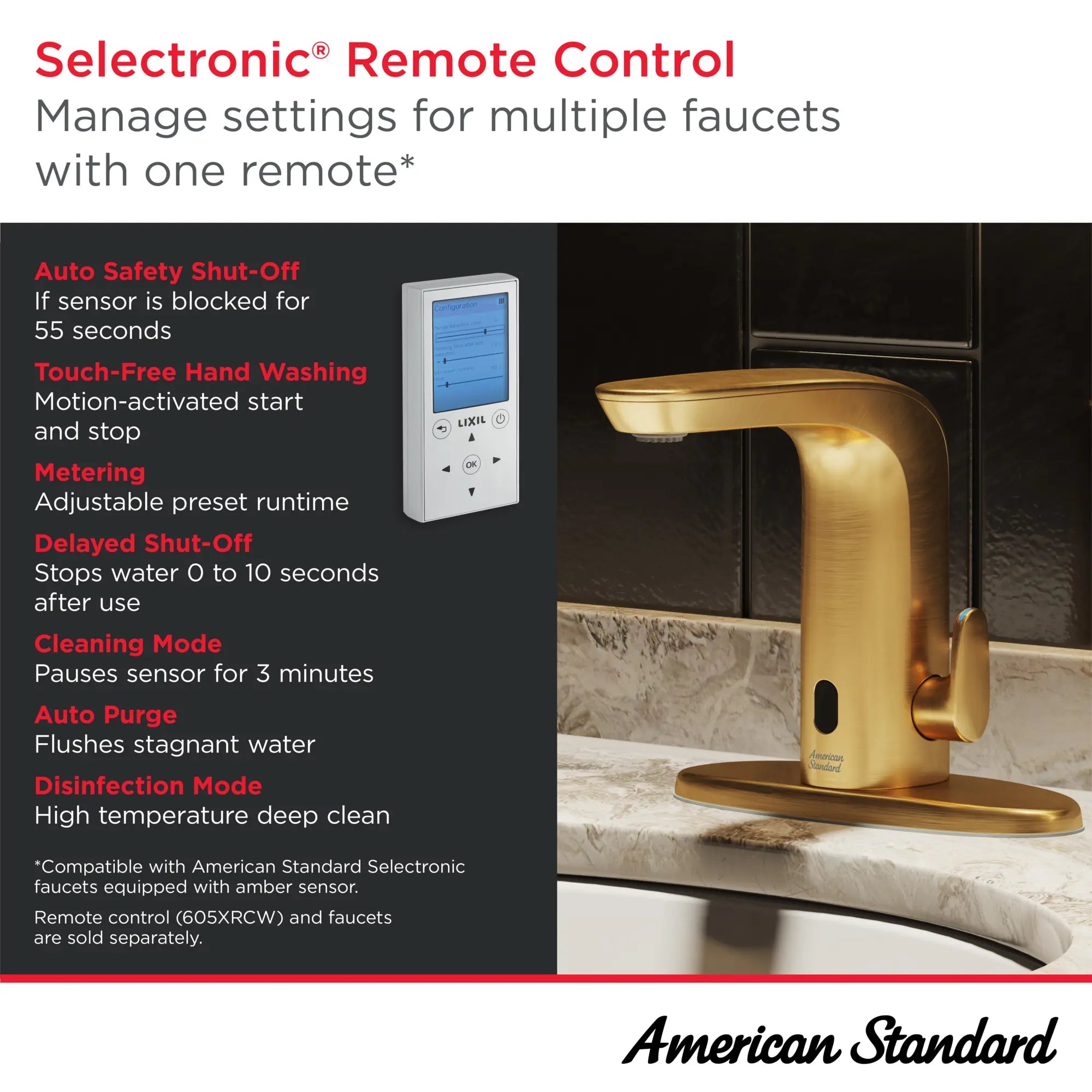
American Standard NextGen Selectronic® Touchless Faucet
American Standard takes a different approach by making the advanced sensor self-calibrating according to environmental and lighting conditions. That can reduce the amount of manual range adjustment required during commissioning.
The electronics are housed above deck within the spout, while automatic shutoff provides another layer of protection against unintended continuous flow.
Automatic environmental calibration reduces dependence on manual tuning.
Self-calibration cannot compensate for every poor faucet-to-basin relationship.
Delta Commercial Proximity® Sensor Faucet
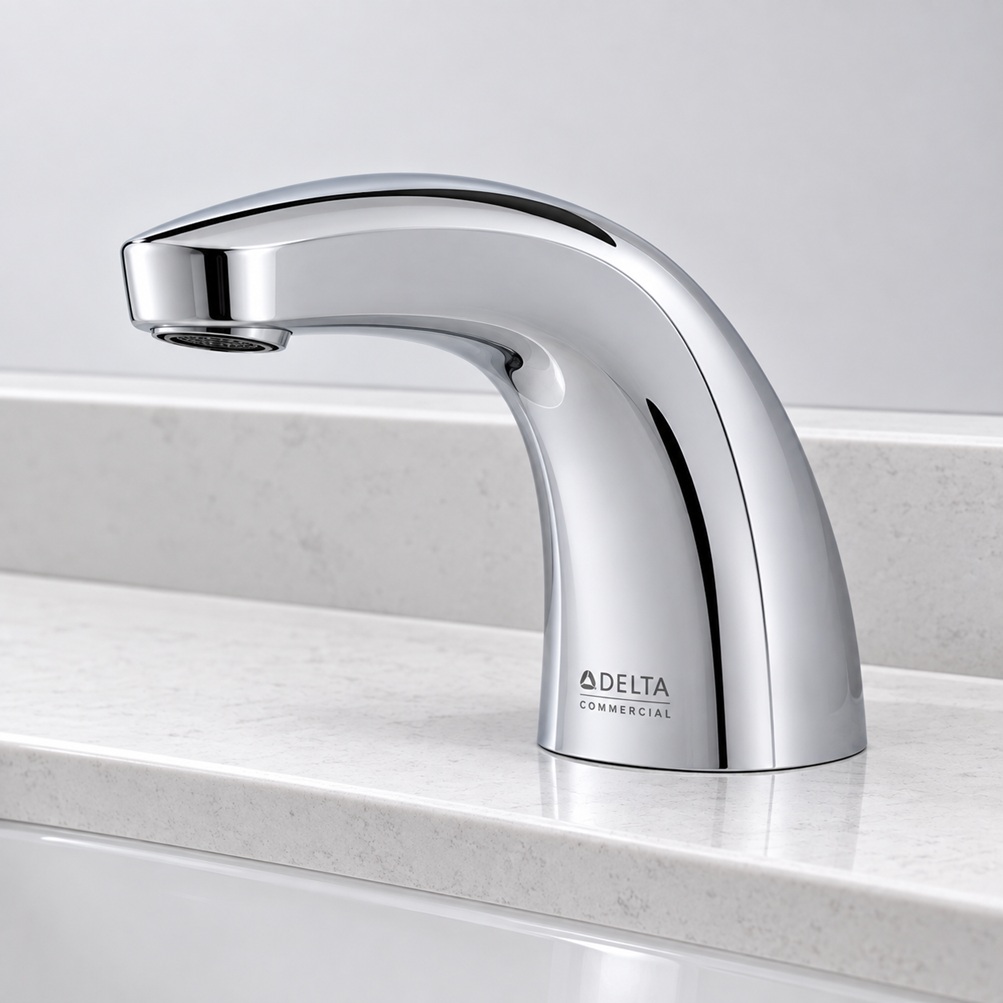
Delta Commercial Electronic Lavatory Faucet with Proximity® Sensing Technology
Delta’s Proximity system makes the entire faucet body part of the sensing architecture rather than depending on a narrow visible window. Delta states that activation is designed to respond rapidly regardless of lighting, reflections or approach direction.
Broad sensing architecture addresses several conventional IR complaints.
Range still requires commissioning to suit actual basin geometry.
Chicago Faucets Alpina® Alento Touch-Free Faucet
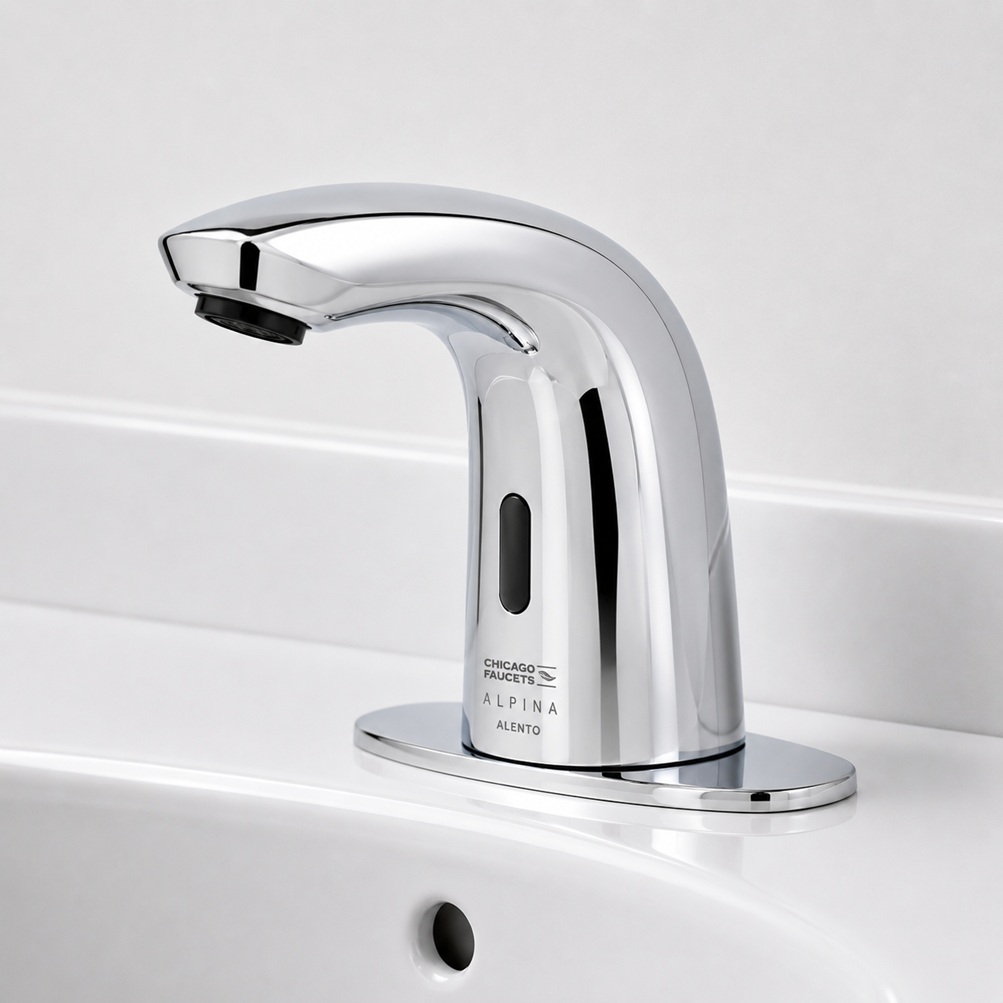
Chicago Faucets Alpina® Alento Touch-Free Faucet
Alento adds Bluetooth-based adjustment through Chicago Faucets’ CF Connect platform. That is useful where commissioning teams want to make operating changes without treating every faucet adjustment as a mechanical service task.
The model also publishes a defined 60-second safety timeout, providing a clear control response when hands or objects remain within the detection zone.
Programmable operating parameters support controlled commissioning.
Greater configuration capability also requires clear facility settings documentation.
Image verification rule: Each product above uses a dedicated product image, displays uncropped at 500+ px on desktop, remains responsive on mobile, and links to the associated product page.
Not Every IR Faucet Behaves the Same
Sloan currently identifies Active Infrared sensing as standard across BASYS models, while selected products also use capacitance sensing for adaptive performance. This distinction illustrates why the word “infrared” alone is not enough to predict real-world behavior.
Signal processing, sensor location, calibration method and faucet geometry can substantially change how two sensor faucets respond even when both rely on infrared technology.
Before Calling the Manufacturer
| Clean the sensor area | Film, soap residue or construction dust can affect detection. |
| Remove objects | Verify nothing remains inside the intended sensing zone. |
| Check basin reflectivity | Polished surfaces can interact differently with some IR layouts. |
| Confirm power | Weak power can be mistaken for a sensing problem. |
| Verify range | Adjustable systems may simply be commissioned too long or short. |
| Review timeout | Understand the manufacturer’s normal safety shutoff behavior. |
Commercial Sensor Platforms Worth Researching
Commercial Sensor Failure FAQ
Why does a touchless faucet activate by itself?
Potential causes include an oversized detection zone, reflective basin surfaces, nearby objects, dirty sensing surfaces or control problems.
Why do users wave their hands repeatedly?
The sensing zone may be too short, poorly positioned or inconsistent with the natural handwashing position.
Can bathroom lighting affect a sensor faucet?
Sensor technologies respond differently. Some advanced systems specifically self-calibrate around environmental and lighting conditions.
Does self-calibration eliminate commissioning?
No. It reduces manual sensor tuning but basin geometry, faucet placement, power and plumbing still require verification.
What protects against continuous flow?
Commercial faucets commonly incorporate safety timeouts that stop water after a defined maximum activation period.
Is a whole-body sensor better than infrared?
It solves the detection problem differently. The best architecture depends on installation conditions and required commissioning control.
Technical Reference Sources
U.S. EPA — Bathroom Faucet Efficiency
Current federal guidance for public and private lavatory faucet efficiency.
American Society of Plumbing Engineers
Professional plumbing-engineering education and commercial specification resources.
U.S. Department of Justice — ADA Standards
Accessibility requirements affecting commercial lavatory and faucet coordination.
U.S. Green Building Council — LEED
Building-performance framework relevant to indoor water-use planning.
The Best Sensor Is the One Users Never Have to Think About
Reliable touchless operation depends on more than sensor type. Basin geometry, calibration, sensing range, environmental response and timeout logic all matter. The Fontana Aeris SenseFlow Brushed Gold Aura provides a strong design-forward commercial option, American Standard reduces manual adjustment through self-calibration, Delta approaches the problem with whole-spout sensing, and Chicago Faucets adds programmable commissioning controls.
Review Fontana Aeris SenseFlow →Independent editorial disclosure: CommercialTouchlessFaucetReviews.com provides technical editorial analysis based on published manufacturer information. Scores are editorial assessments, not laboratory certifications or claims of physical testing. Always confirm current manufacturer specifications and perform project-specific commissioning.