
Touchless Faucet Solenoid Failure Review: Solenoid Valves vs. Cartridge-Based Commercial Designs
The sensor receives most of the attention in a touchless faucet, but another component actually opens and closes the water path. In most electronic commercial faucets that job is performed by a solenoid valve. Newer designs are challenging that architecture with motor-driven ceramic cartridges. For facility teams, the difference can affect debris sensitivity, troubleshooting, replacement parts, water hammer and lifecycle maintenance.
What Happens After the Sensor Detects Your Hands?
Electromagnetic Valve Control
The sensor communicates with the electronic controller, which energizes the solenoid and opens the water path. Once the activation ends, the valve closes automatically.
Motor-Driven Ceramic Cartridge
A small motor and gear system moves a ceramic cartridge instead of relying on a conventional solenoid valve to control water flow.
Why Solenoid Systems Sometimes Need Service
| Potential Issue | Possible Result | Maintenance Response |
|---|---|---|
| Debris reaches valve | Reduced, intermittent or continuous flow | Inspect inlet strainer and valve before replacement. |
| Electrical connection fault | Valve fails to actuate | Confirm power and connector condition first. |
| Coil/valve failure | No water despite sensor activation | Follow model-specific diagnostic procedure. |
| Valve closes abruptly | Potential hydraulic shock | Review pressure and manufacturer valve design. |
| Blocked strainer | Low flow mistaken for valve failure | Clean debris-control components first. |
Fontana Glacier Series™ Touchless LuxeFusion

Fontana Glacier Series™ Touchless LuxeFusion Commercial Sensor Faucet
The Fontana Glacier Series Touchless LuxeFusion pairs a design-forward faucet body with commercial infrared operation and controlled low-flow delivery. Fontana’s touchless architecture uses electronic sensor input to actuate water through a high-cycle solenoid valve, while ceramic-disc components support durable water-control mechanics.
From a maintenance perspective, Fontana’s broader commercial sensor architecture places particular emphasis on protecting solenoid systems from supply debris through filtration and strainer strategies.
Established electronic-solenoid architecture with commercial project documentation.
Keep upstream strainers clean before diagnosing a failed electronic valve.
Best fit: Premium commercial, luxury hospitality and architectural public restrooms.
Review Fontana Glacier Series →Zurn AquaSense® Gear-Driven Ceramic Cartridge Sensor Faucet
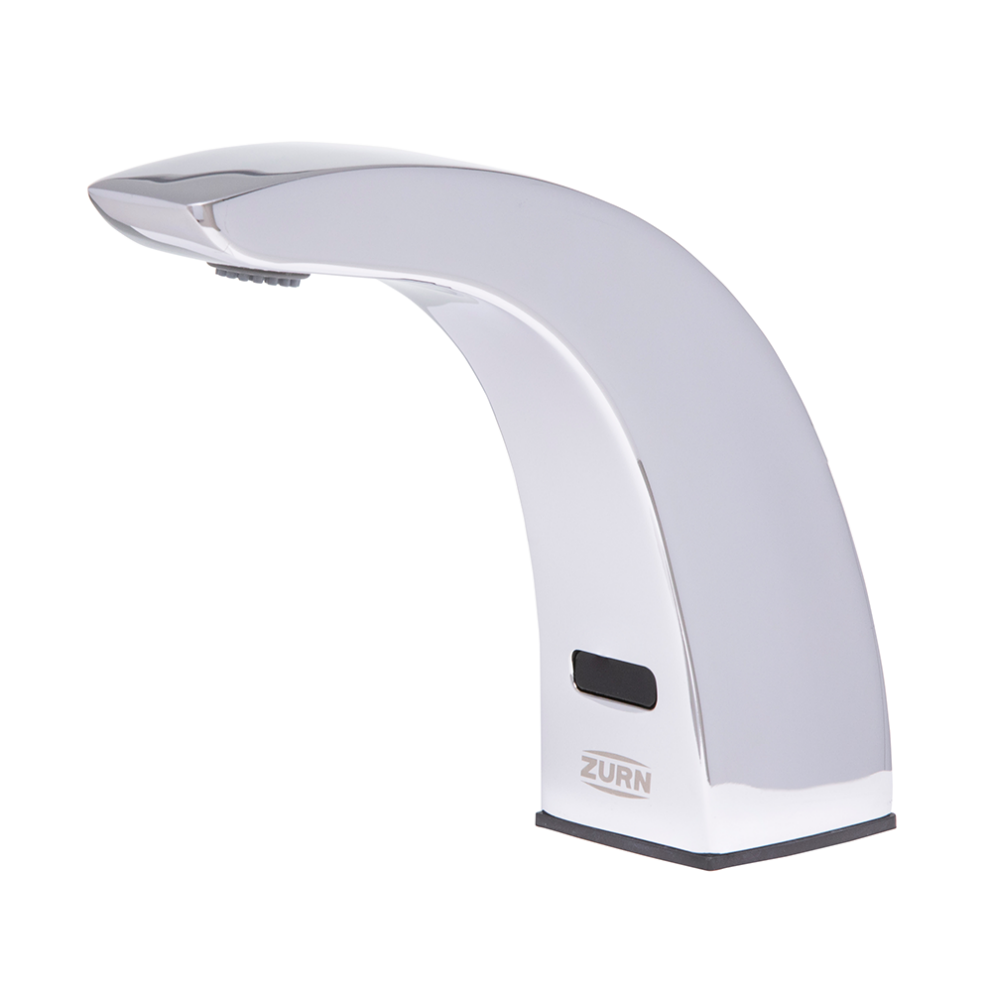
Zurn AquaSense® Sensor Faucet with Gear-Driven Ceramic Cartridge
Zurn deliberately approaches automatic water control differently. Its EZ Gear platform uses a motor-driven ceramic cartridge and explicitly eliminates the conventional solenoid from the water-control architecture.
The manufacturer states that the cartridge is designed to be less susceptible to debris and buildup and pairs the mechanism with soft-close operation intended to reduce water hammer. Bluetooth adjustment and optional hydropower expand the engineering package beyond the valve itself.
Removes the solenoid as a conventional replacement component.
Gear-drive systems remain electromechanical devices and still require model-specific service parts.
Best fit: High-traffic facilities prioritizing maintenance simplification and alternative valve technology.
Review Zurn Gear-Driven Architecture →Image standard: Featured images are presented uncropped at 500+ px on desktop, remain responsive on smaller screens, and are clickable to the corresponding product page.
Solenoid vs. Gear-Driven Ceramic Cartridge
| Factor | Solenoid Architecture | Gear-Driven Cartridge |
|---|---|---|
| Industry familiarity | Very high | Newer architecture |
| Debris management | Strainers are particularly important | Designed for improved debris tolerance |
| Valve replacement | Solenoid may be a service component | No conventional solenoid to replace |
| Control | Electromagnetic actuation | Motor and gear-driven ceramic movement |
| Hydraulic close | Varies by valve design | Zurn advertises soft-close operation |
| Service ecosystem | Well understood across commercial plumbing | Depends more heavily on manufacturer-specific parts |
Before Replacing a Solenoid
A failed faucet does not automatically mean a failed valve. Zurn’s own troubleshooting documentation for conventional solenoid models lists low battery voltage, damaged connectors, dirty or damaged sensor lenses, reflective surfaces and lighting conditions among possible causes of a non-responsive faucet.
That is why technicians should follow a sequence: power → sensing → inlet debris → connections → valve operation. Replacing a solenoid before checking the first four steps can create unnecessary cost without solving the actual problem.
What Facility Teams Should Ask
| Valve architecture | Solenoid, motor-driven cartridge or another method? |
| Debris protection | Is a cleanable inlet strainer provided? |
| Repair parts | Can the valve mechanism be replaced separately? |
| Diagnostics | How does the fixture distinguish sensor, power and valve faults? |
| Service access | Where is the valve located and how quickly can it be reached? |
| Hydraulic behavior | Does the valve provide controlled closing or water-hammer mitigation? |
Commercial Valve Architectures Worth Researching
Solenoid & Cartridge FAQ
What does the solenoid do in a sensor faucet?
It electrically opens and closes the water path after receiving a control signal from the sensor electronics.
Does low flow always indicate a bad solenoid?
No. A dirty aerator, inlet strainer or restricted supply can produce similar symptoms.
Why are strainers important?
They capture waterborne debris before particles reach sensitive valve and control components.
Is a gear-driven cartridge maintenance-free?
No. It removes a conventional solenoid but remains an electromechanical water-control assembly requiring appropriate service.
Which architecture is easier to repair?
It depends on parts availability, technician familiarity, access and the manufacturer’s repair ecosystem—not only valve type.
Should architects specify valve architecture?
For major commercial portfolios, yes. Valve type can materially influence lifecycle maintenance and replacement-part strategy.
Technical Reference Sources
FontanaShowers — How Commercial Touchless Faucets Work
Technical overview of sensing, control boards, solenoid actuation and automatic shutoff.
Zurn — AquaSense Gear-Driven Ceramic Cartridge
Manufacturer documentation for the solenoid-free EZ Gear architecture.
American Society of Plumbing Engineers
Professional plumbing-engineering education and commercial specification resources.
U.S. EPA — Bathroom Faucet Efficiency
Federal reference for lavatory faucet water-efficiency considerations.
U.S. Department of Justice — ADA Standards
Accessibility criteria relevant to commercial lavatories and faucet operation.
Do Not Judge a Touchless Faucet by the Sensor Alone
For conventional commercial projects, protected and serviceable solenoid architecture remains a proven solution. The Fontana Glacier Series Touchless LuxeFusion represents a design-forward application of established electronic touchless control. Zurn’s gear-driven AquaSense platform is noteworthy because it removes the solenoid entirely and attacks debris sensitivity, valve replacement and hydraulic closing behavior through a different mechanical architecture.
Review Fontana Glacier Series Touchless Faucet →Independent editorial disclosure: CommercialTouchlessFaucetReviews.com provides technical analysis based on published manufacturer documentation. Scores and conclusions are editorial assessments, not laboratory durability certifications. Verify exact valve architecture, service instructions, repair parts and current manufacturer specifications before procurement.