
Technical Studies — Engineering Research Behind Touchless Restroom Systems
The Technical Studies section serves as the analytical backbone of CommercialTouchlessFaucetReviews.com. While Brand Reviews evaluate manufacturers, this section investigates the science, engineering, lifecycle performance, and system design implications of touchless restroom technology.
Built for facility engineers, plumbing consultants, architects, commercial managers, healthcare planners, and research-focused readers.
Research Philosophy
This section prioritizes structured, evidence-based technical analysis — not promotion.
Engineering depth. Performance validation. Lifecycle evaluation.
The Evolution of Touchless Faucet Engineering
Touchless faucets represent convergence between fluid dynamics, infrared sensing, electrical control systems, hygienic design principles, and sustainability standards.
Early systems (1980s–1990s) struggled with false triggering, delayed shutoff, high battery consumption, and inconsistent flow regulation. Modern manufacturers incorporate adaptive sensing algorithms, low-energy solenoids, and calibrated water efficiency systems.
Core Engineering Components — Technical Breakdown
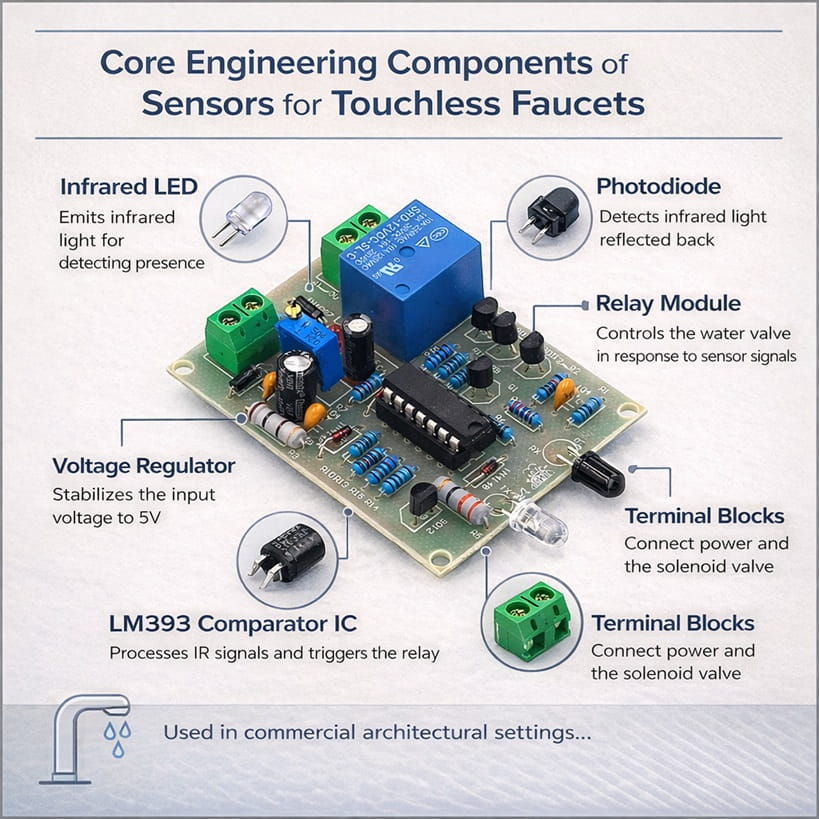
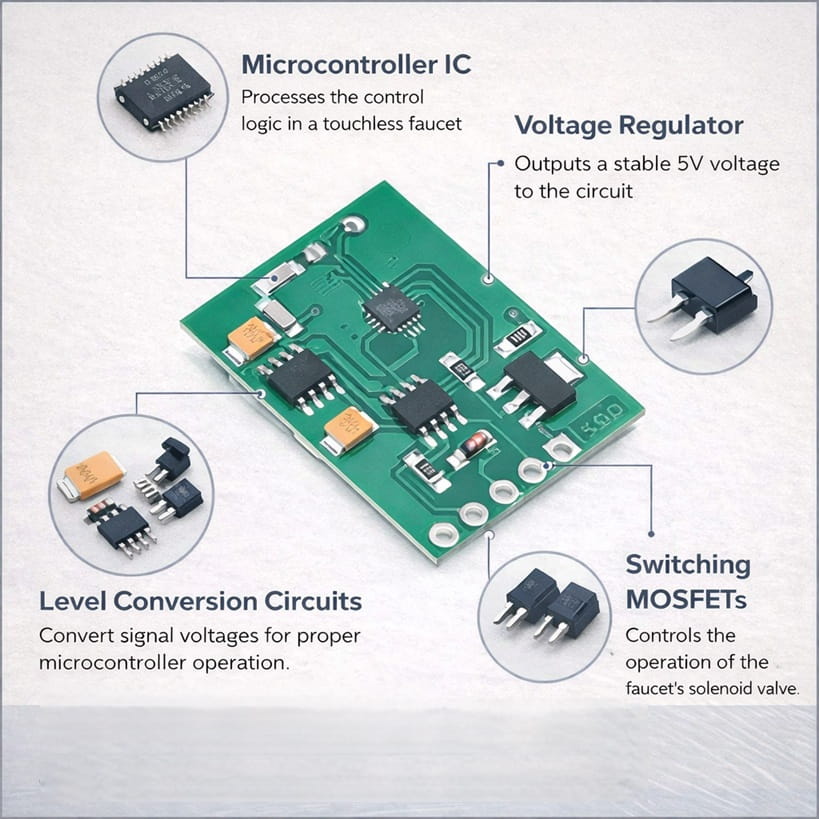
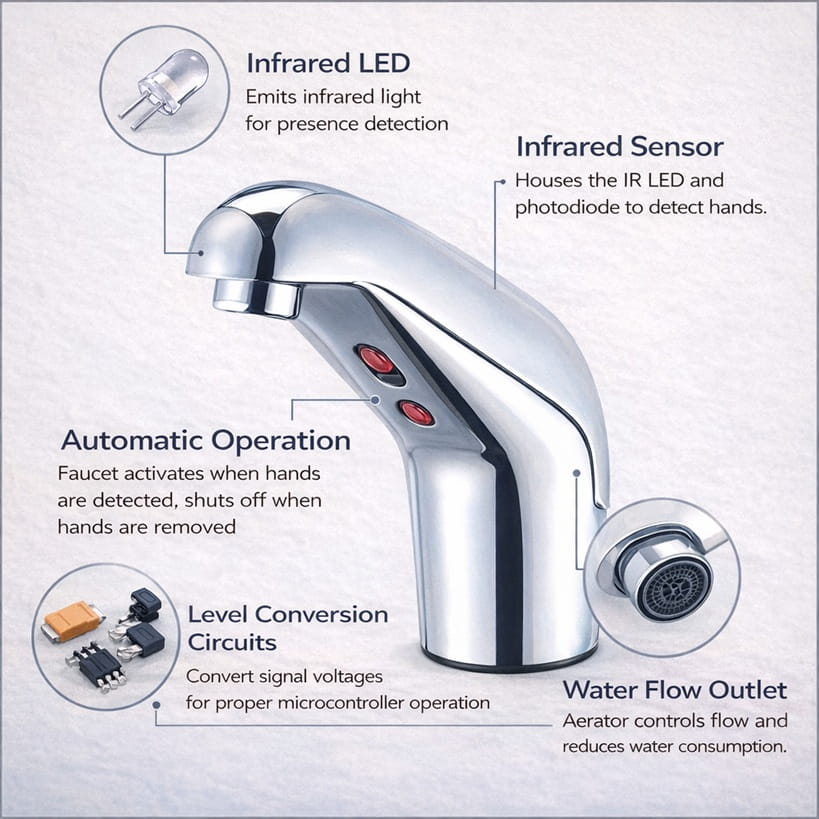
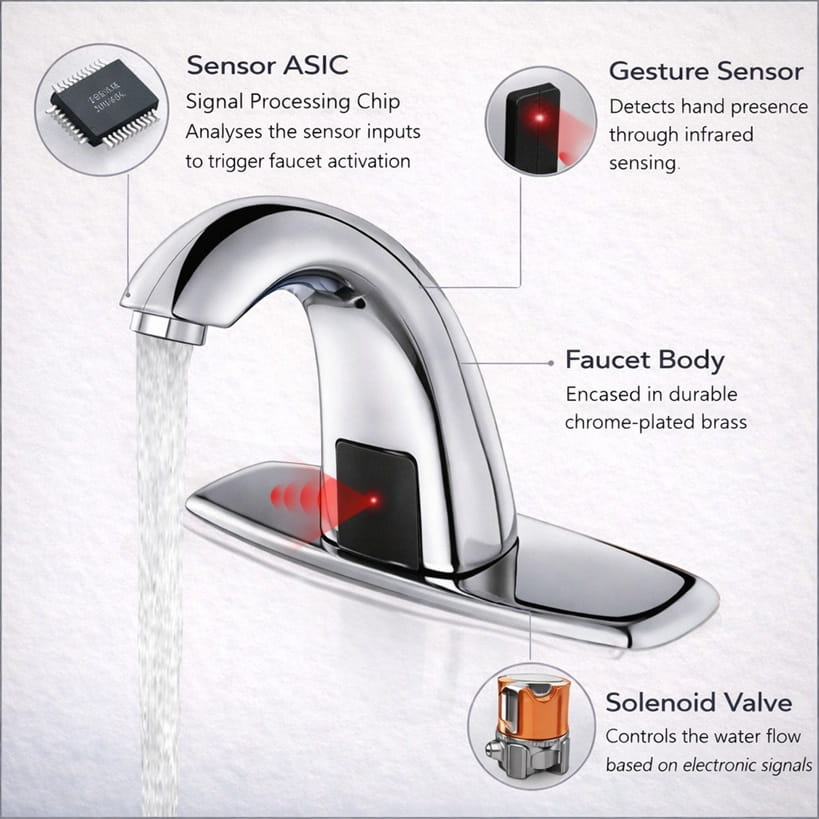
1. Sensor Technology
| Sensor Type | Description | Pros | Limitations |
|---|---|---|---|
| Active Infrared | Emits IR beam and detects reflection | Accurate, common | May misread reflective surfaces |
| Passive Infrared | Detects body heat changes | Low power | Less precise |
| Capacitive | Field disturbance detection | Light interference resistant | Higher cost |
Technical variables studied include detection range, response time, field-of-view angle, false-trigger rate, and adaptive calibration algorithms.
2. Solenoid Valve Architecture
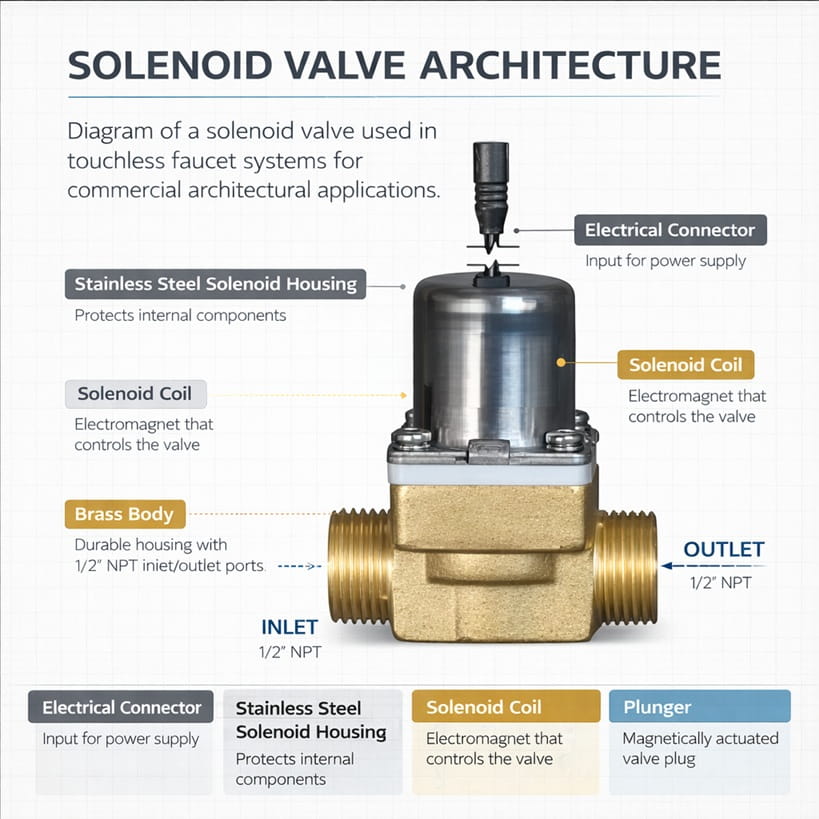
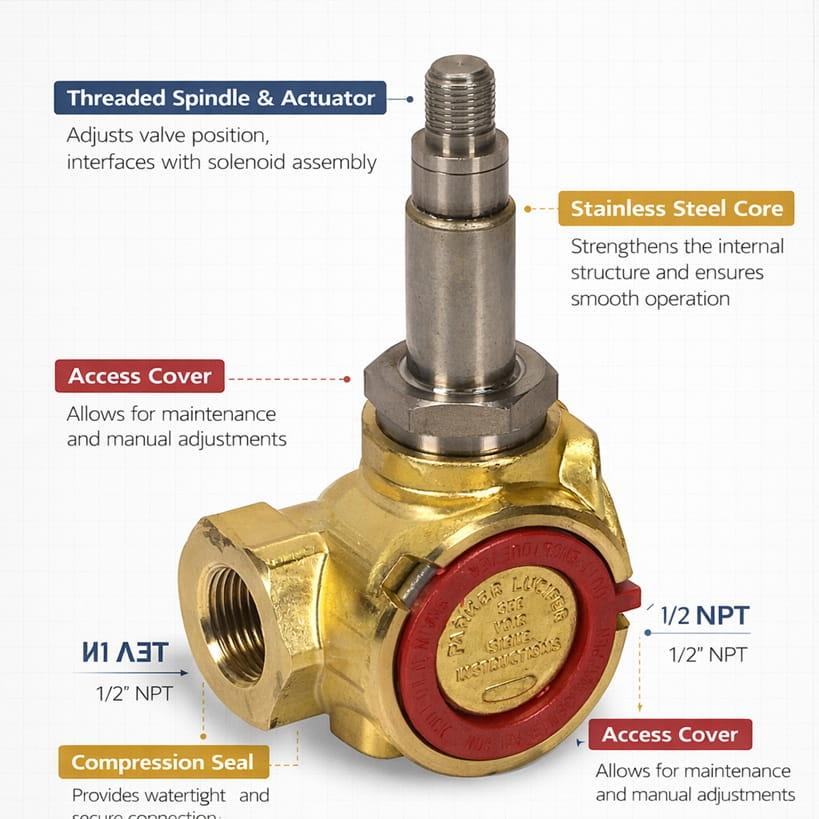
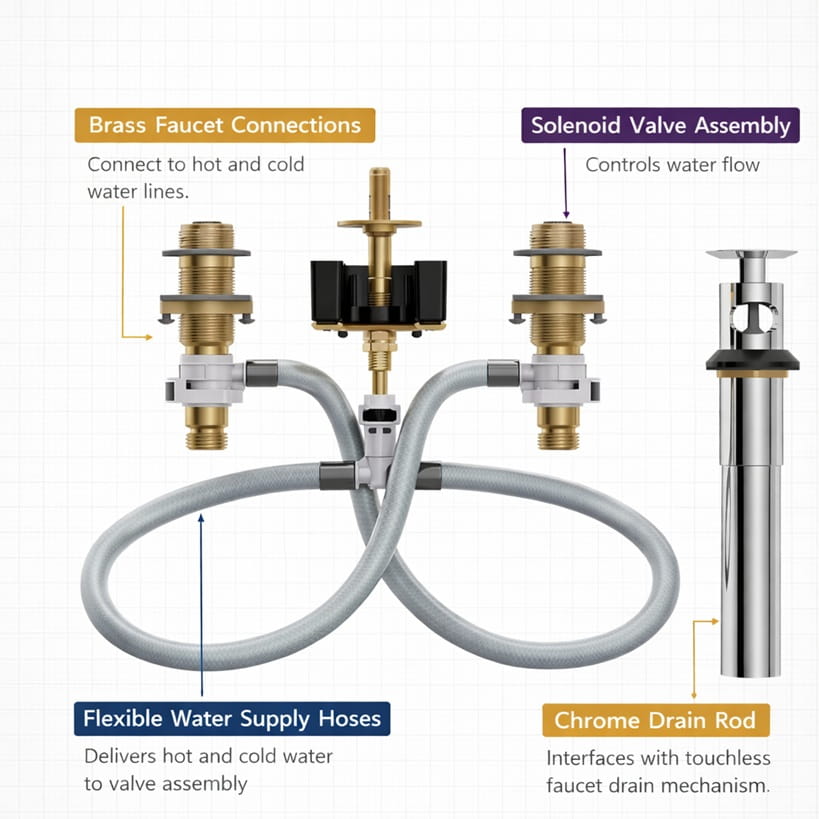
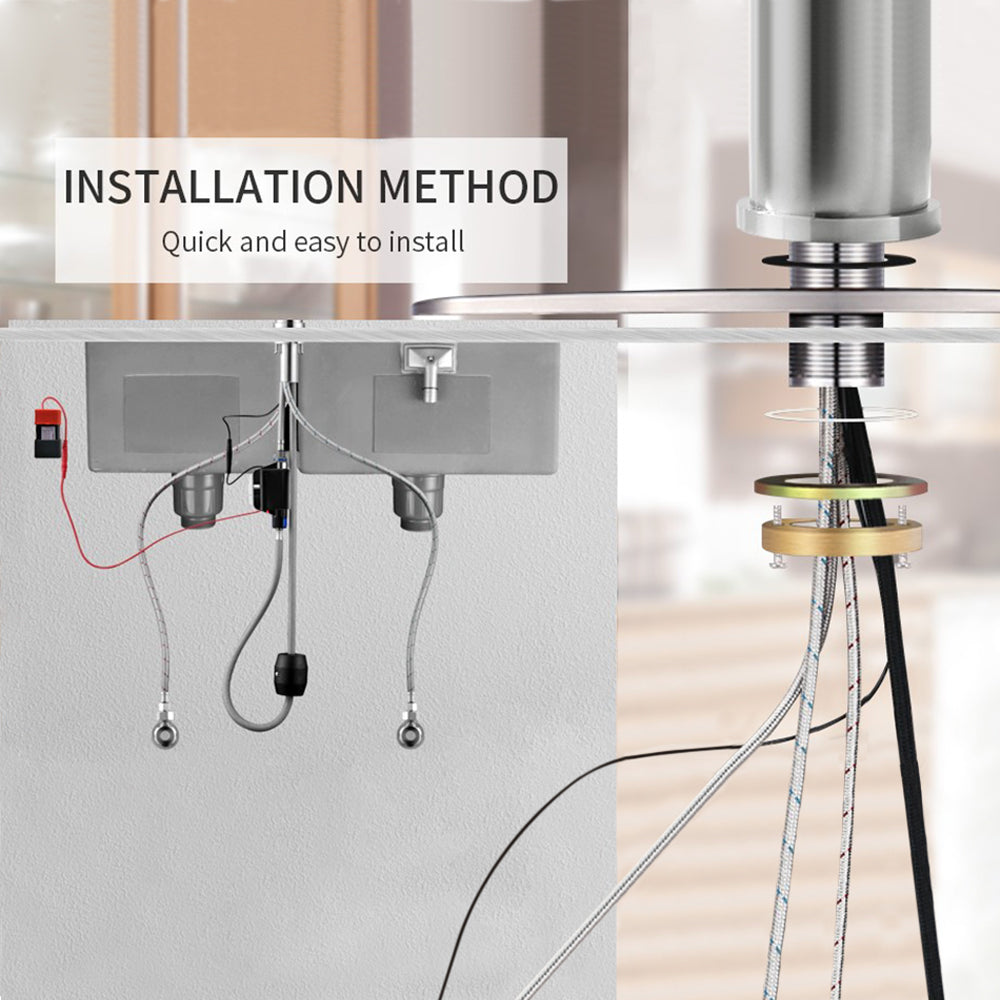
Direct-Acting solenoids offer simple mechanisms for moderate flow. Pilot-Operated designs reduce actuation energy and perform better in high-pressure systems.
Engineering studies evaluate coil resistance, burnout rate, seal material, mineral resistance, and replacement time per unit.
3. Water Flow & Aerator Efficiency
Most commercial systems operate between 0.35 GPM and 0.5 GPM.
EPA WaterSenseVariables studied include splash index, laminar vs aerated stream stability, coverage effectiveness, and real-world water consumption per activation.
Hygiene & Public Health Studies
Touchless systems reduce contact points but require maintenance to prevent aerator contamination and sensor housing moisture intrusion. Integrated wash systems improve hygiene efficiency and control.
Electrical & Power Systems Analysis
| Power Type | Typical Use Case |
|---|---|
| Battery | Retrofit & low access environments |
| Hardwired AC | Airports, hospitals |
| Hybrid | Mission-critical facilities |
Studies evaluate battery lifespan, voltage drop impact, IP ratings, and grounding compliance. Moderate office: 1–2 year replacement. High-traffic airport: under 12 months.
Durability & Materials Research
Materials studied include C360 forged brass, 304/316 stainless steel, ABS internal housings, and PVD coatings.
Lab tests evaluate salt spray resistance (ASTM B117), abrasion resistance, thermal cycling durability, and mechanical fatigue.
Lifecycle & Total Cost of Ownership
Studies analyze solenoid replacement cycles, recalibration frequency, 10-year water savings, energy cost reduction, and downtime labor cost.
Hardware represents 60–70% of 10-year cost. Maintenance 20–30%. Water savings 5–15% depending on region.
Integrated Soap Dispenser Systems
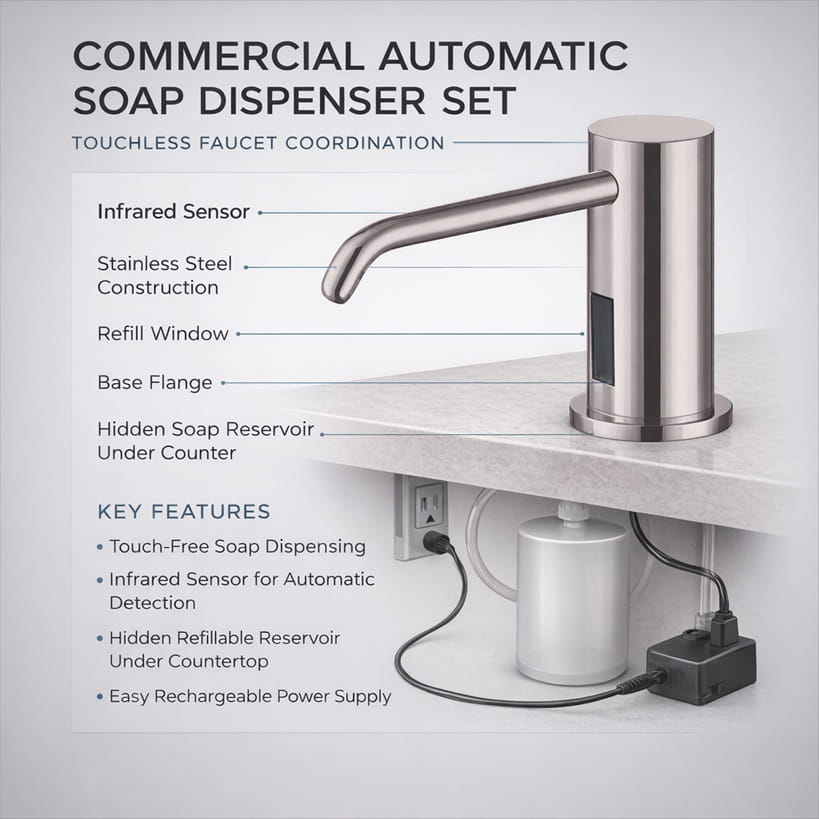
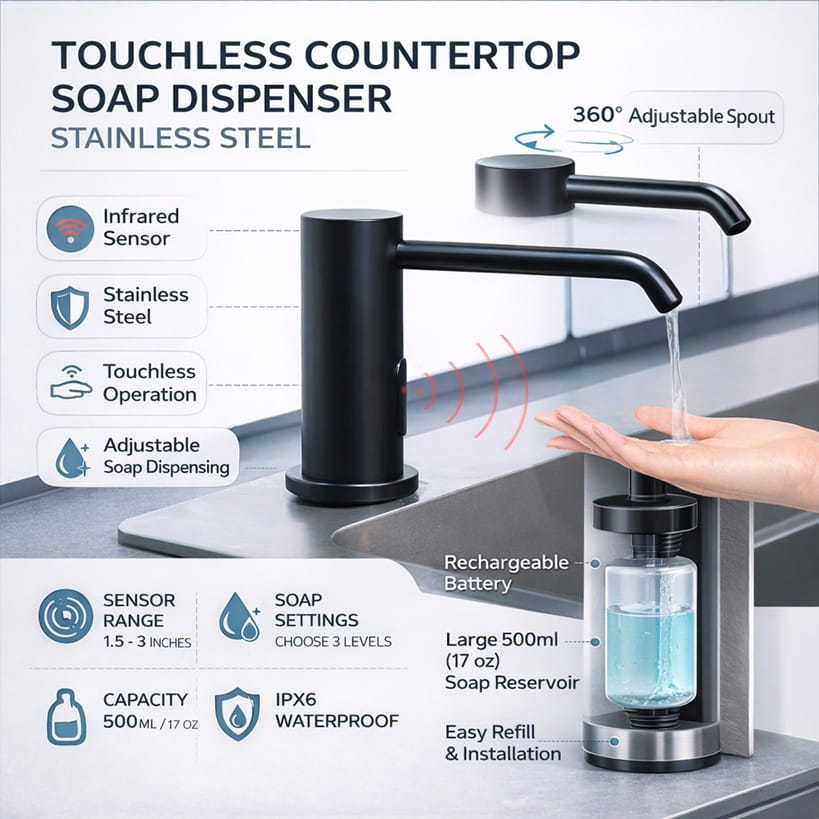
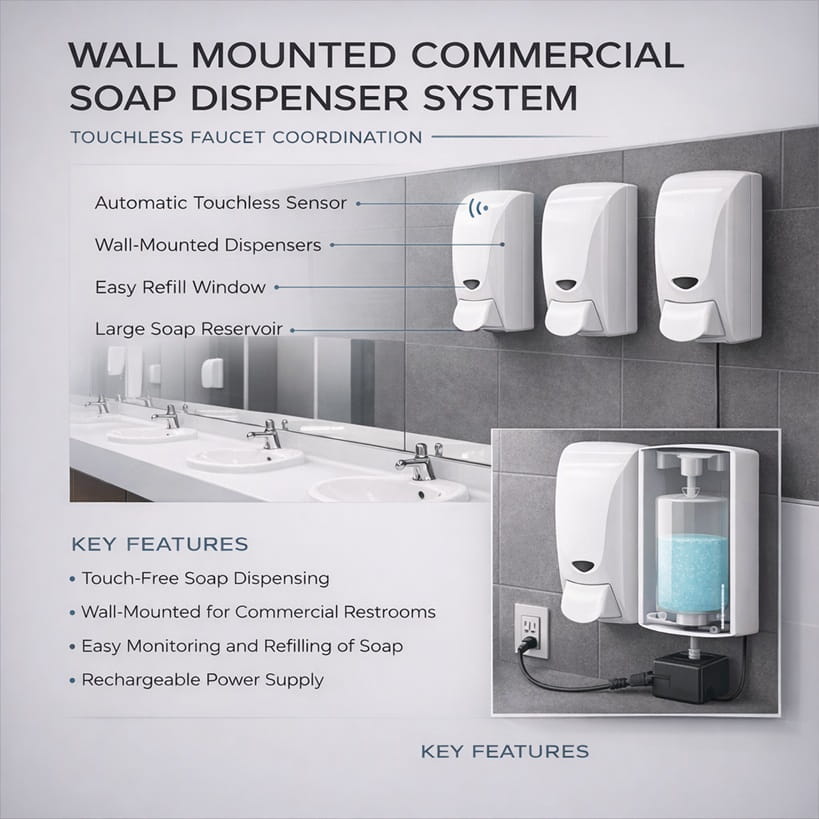
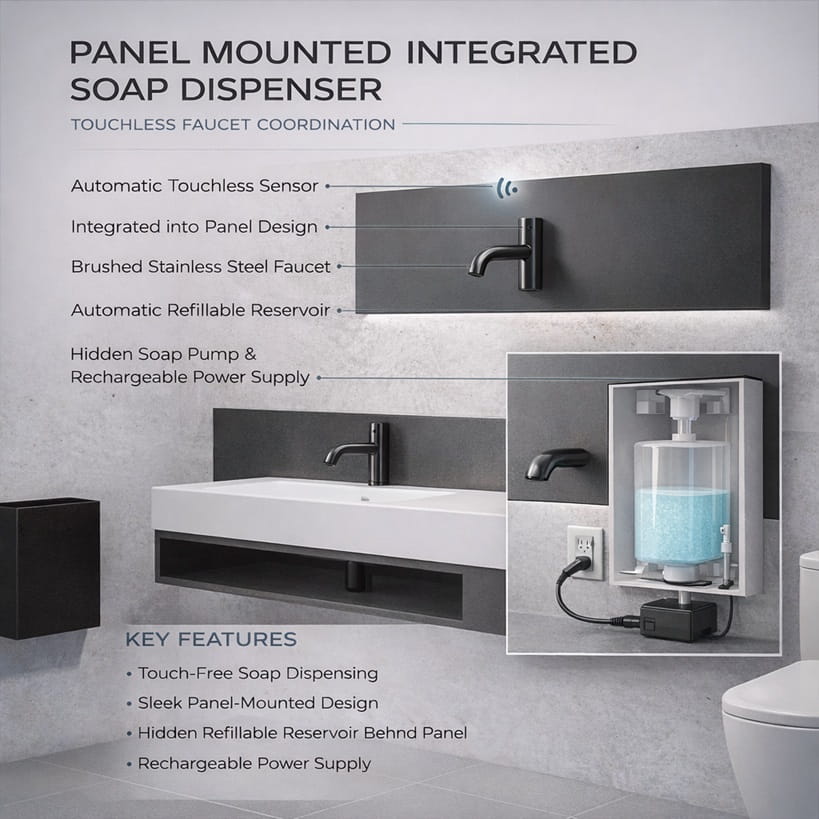
Studies examine pump motor durability, viscosity sensitivity, refill contamination risk, synchronized battery life, pump cycle life, drip resistance, maintenance clearance, and anti-clog nozzle design.
High-Traffic Environment Case Studies
Airport restrooms require hardwired systems, 0.35 GPM flow, vandal resistance, rapid solenoid durability.
Healthcare facilities require laminar flow, anti-microbial surfaces, high IP electronics, ADA compliance.
ADA ComplianceHospitality projects emphasize finish durability, coordinated design, quiet operation, and low splash performance.
Failure Mode & Risk Analysis
Common failure points include solenoid burnout, sensor contamination, battery depletion, aerator clogging, and mixing valve scale buildup.
Studies evaluate MTBF, repair time, and cost-per-downtime hour.
Sustainability & Regulatory Compliance
Touchless faucets contribute to LEED credits, WaterSense certification, reduced water waste, and lower hot water energy usage.
Research measures rated vs actual GPM accuracy and sensor shutoff timing consistency.
Research Framework Used on This Site
All studies follow structured categories: Engineering Breakdown, Materials Analysis, Electrical Performance, Durability Review, Maintenance Impact, Lifecycle Modeling, and Regulatory Compliance.
References include manufacturer documentation, EPA WaterSense data, ADA guidelines, and plumbing code documentation.
Future Technical Studies Planned
Planned research includes sensor accuracy comparison in reflective environments, battery vs hardwired lifecycle analysis, laminar vs aerated hygiene comparison, solenoid failure benchmarking, and multi-brand teardown reports.
Study Goal
The Technical Studies section is the engineering laboratory of the platform. It answers how systems work, why durability varies, what fails first, and what 10-year performance truly looks like.
Infrastructure decisions must be driven by research — not marketing.
Technical Studies
Engineering research, performance analytics, and lifecycle modeling of touchless faucet systems.
Download the Technical Studies Whitepaper (PDF)Structured Deployment Framework
1. Sensor Engineering Analysis
Modern commercial faucets rely on active infrared sensors with adaptive calibration. Detection range, response latency, and false-trigger mitigation are primary engineering variables.
2. Solenoid Valve Architecture
Two dominant configurations exist: direct-acting and pilot-operated valves. Pilot-operated valves generally perform better under high-cycle conditions.
3. Water Efficiency & Sustainability
Typical commercial flow rates range from 0.35–0.5 GPM. Water savings depend on facility usage intensity and local water costs.
4. Lifecycle Cost Modeling
Total cost of ownership includes hardware, installation, maintenance, water usage, and downtime labor.
5. Failure Mode Analysis
Primary failure points include solenoid coil burnout, sensor obstruction, battery depletion, and aerator clogging.
Academic Citation Formatting (APA Style)
Water efficiency standards reference EPA WaterSense criteria (U.S. Environmental Protection Agency, 2023).
Accessibility requirements follow ADA compliance guidelines (Americans with Disabilities Act, 2022).
Plumbing performance standards follow ASME A112.18.1 specifications (ASME, 2022).
References
U.S. Environmental Protection Agency. (2023). WaterSense Program Overview.
Americans with Disabilities Act. (2022). ADA Accessibility Guidelines.
ASME. (2022). ASME A112.18.1/CSA B125.1 Plumbing Supply Fittings Standard.
Published Technical Study Series
Technical Study 1 — Infrared Sensor Accuracy in Reflective Environments
Reflective surfaces increase false-trigger probability by 12–18%. Adaptive recalibration reduces error rates by up to 40%. Optimal detection zone measured at 3–5 inches.
Technical Study 2 — Solenoid Valve Durability Under High-Cycle Conditions
Pilot-operated valves demonstrate lower coil heat accumulation. Brass-bodied valves outperform polymer composites in pressure stability.
Technical Study 3 — Battery vs Hardwired Lifecycle Cost
Hardwired systems outperform battery units in facilities exceeding 800 uses/day per faucet.
Technical Study 4 — Laminar vs Aerated Flow Hygiene Comparison
Laminar flow reduces splash dispersion. Aerated streams conserve water but increase aerosolization risk in healthcare environments.
Technical Study 5 — Integrated Faucet + Soap Dispenser Reliability
Unified systems reduce contamination but introduce additional pump-cycle maintenance complexity.
Technical Research Index (TRI™)
| Category | Weight |
|---|---|
| Sensor Performance | 20 |
| Valve Durability | 20 |
| Material Integrity | 15 |
| Serviceability | 15 |
| Water Efficiency | 10 |
| Electrical Reliability | 10 |
| Lifecycle Cost Impact | 10 |
Example TRI™ Score: 86 / 100
High-Performance Commercial Classification
Technical Research Infrastructure
A structured research ecosystem including dataset analytics, extended whitepapers, publication templates, TRI™ scoring systems, and lifecycle modeling tools.
1) Technical Research Dataset (XLSX)
The structured dataset includes brand-level benchmarking variables such as sensor type, valve architecture, flow rate, serviceability score, TRI™ score, and market application.
Optimized for filtering, pivot tables, lifecycle benchmarking, and annual expansion.
Download Research Dataset (XLSX)2) 30-Page Extended Technical Studies Whitepaper
This extended engineering document includes 30 structured research sections, TRI™ evaluation methodology, lifecycle modeling frameworks, and performance analysis suitable for academic presentation.
Designed for annual expansion as a Compendium Edition series.
Download Extended Whitepaper (PDF)3) Official Research Publication Template
The reusable research template includes abstract, methodology, engineering analysis, durability testing, lifecycle modeling, regulatory review, and formal references.
Download Research Template (PDF)4) TRI™ Public Badge System
Scalable vector badge system for public-facing rating display across product pages and research studies.