
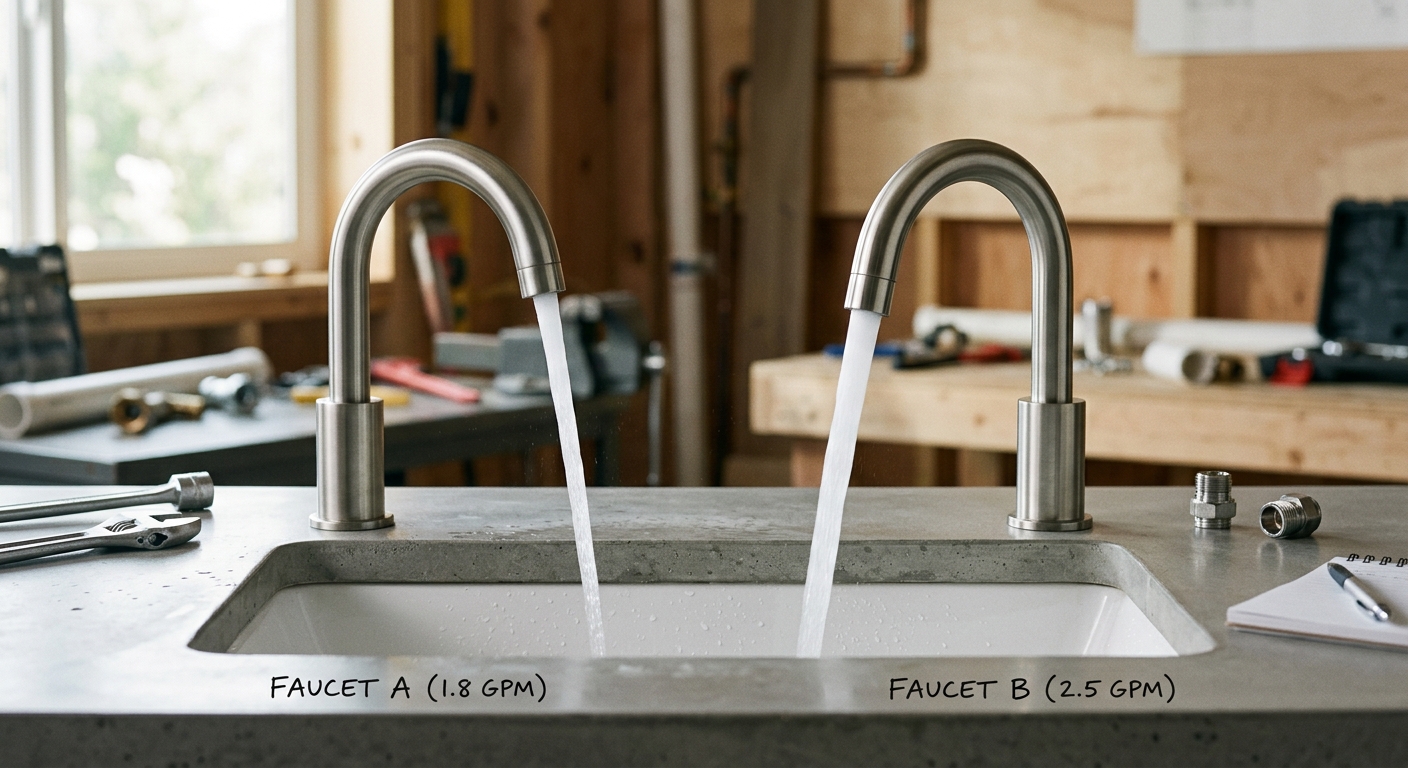
Pick 1.8 gpm for high-traffic public restrooms where code compliance and water budgets drive the spec. Pick 2.5 gpm where hand-wash dwell time matters more than utility cost, such as healthcare scrub areas or kitchens with grease and food debris. Run both through the same six-category rubric below and the answer becomes a numbers problem, not a preference.
The Fixed Rubric Applied to Flow Rate
Every faucet on this blog gets scored on the same six categories: flow performance, code compliance, hand-wash dwell time, splash and aerator behavior, retrofit fit, and maintenance. Each category is worth up to 10 points, weighted equally, for a possible 60. Flow rate alone does not decide the winner, but it drags three categories in opposite directions at once: code compliance favors the lower number, dwell time favors the higher one, and splash behavior depends on aerator choice more than gpm.
The baseline numbers do not move. EPA WaterSense sets 1.5 gpm as its certification threshold for commercial lavatory faucets. Federal maximum is 2.2 gpm at 60 psi for many fixtures, but the touchless commercial faucets under review here ship at either 1.8 gpm or 2.5 gpm, so those are the two baselines scored throughout this post.
1.8 GPM: Where It Scores Well
1.8 gpm sits close enough to the WaterSense 1.5 gpm line that most manufacturers can hit certification with a minor aerator swap, which matters if the spec calls for WaterSense-labeled fixtures on a LEED or municipal water-reduction project. In the rubric, this earns a 9 or 10 on code compliance in nearly every jurisdiction still running current IPC or UPC cycles.
Maintenance scores also favor 1.8 gpm faucets in this review set, though not because of the flow rate itself. Lower flow reduces mineral scale buildup speed in the aerator screen, which in hard-water regions translates to fewer service calls per year. That is a maintenance-category point, not a flow-performance point, and the rubric keeps them separate for exactly this reason.
Where 1.8 gpm loses ground is flow performance under load. A single user rinsing hands scores fine. A trough sink with three sensor heads running at once, each pulling 1.8 gpm, can feel underpowered if the building’s supply pressure is already marginal. That is a flow-performance deduction, not a compliance issue.
2.5 GPM: Where It Scores Well
2.5 gpm wins the dwell-time category outright in this rubric. More volume per second means a full hand-wash cycle, wetting, lathering rinse, and final rinse, completes faster under the same sensor activation window. In busy multi-user restrooms this reduces queue time at the sink bank, which is a measurable field observation, not a marketing claim.
It also scores well on retrofit fit in older buildings with low static pressure. Where 1.8 gpm faucets sometimes need pressure-compensating cartridges to hit rated flow, 2.5 gpm units running through the same low-pressure supply line often reach usable flow without added hardware. That keeps retrofit-fit scores higher for 2.5 gpm in buildings built before current plumbing codes tightened supply requirements.
The tradeoff shows up immediately in code compliance. Several current adopted code cycles cap public lavatory flow well below 2.5 gpm, and jurisdictions on the latest IPC or UPC cycle will flag a 2.5 gpm commercial lavatory faucet outright. That is a hard point loss in the rubric, not a judgment call.
Rinse Time and Dwell Under Sensors
Dwell time in this rubric is measured as the interval between sensor activation and a complete rinse cycle at typical hand-wash technique, not manufacturer-stated flow alone. Two variables move that number independently of gpm: sensor range setting and aerator stream pattern.
Sensor range settings, usually adjustable from 4 to 12 inches on the units reviewed here, control how quickly the valve opens and how long it stays open per approach. A faucet set to a tight 4-inch range activates late and closes early, which can undercut even a 2.5 gpm unit’s dwell-time score if users pull hands back mid-wash. A wider range setting closer to 8 to 10 inches keeps the valve open through a full wash motion and lets the rated flow actually deliver rinse performance. This is a setup variable installers control at commissioning, and it belongs in the same conversation as gpm because it can swing the dwell-time score by two or three points independent of the faucet’s spec sheet.
Aerator type also affects perceived rinse speed. A laminar-flow aerator delivers a clear, low-splash stream but can feel slower to rinse soap because the stream stays tight and narrow. A spray-pattern aerator covers more hand surface per second, improving perceived dwell time, at the cost of splash score, covered next.
Splash and Aerator Behavior Score
Splash behavior is scored separately from flow rate because aerator geometry, not gpm, determines it in most of the units tested. Laminar-flow aerators consistently score highest here regardless of whether the faucet runs 1.8 or 2.5 gpm, because the non-aerated, non-turbulent stream sheets down into the basin rather than fanning outward.
Spray and standard aerated cartridges introduce more turbulence and air mixing, which raises splash risk at both flow rates, but the effect is more noticeable at 2.5 gpm simply because there is more water moving through the same orifice geometry. A 2.5 gpm faucet with a laminar aerator will usually out-score a 1.8 gpm faucet running a cheap spray aerator on this category, which is the main reason the rubric treats aerator type as its own variable rather than folding it into flow performance.
For buyers shortlisting a specific product line, checking the aerator spec sheet before checking the gpm number saves a step. Several manufacturers list motion sensor faucets with interchangeable aerator cartridges, which lets a facility swap laminar for spray without replacing the sensor body or solenoid valve, a detail worth confirming before locking in a bulk order.
Code Compliance Scoring by Jurisdiction
Code compliance is the category where 1.8 and 2.5 gpm faucets diverge most sharply, and the divergence is jurisdiction-dependent rather than universal. The table below reflects how this rubric scores each flow rate against common code postures. Always verify against the locally adopted code cycle and any state amendments before finalizing a spec, since amendments frequently override the base IPC or UPC language.
| Jurisdiction posture | 1.8 gpm score | 2.5 gpm score |
|---|---|---|
| Current IPC/UPC cycle, no local amendment | 9-10 | 3-5, often non-compliant for public lavatories |
| Older code cycle, no flow cap below 2.5 gpm | 8-9 | 8-9 |
| State WaterSense mandate for public buildings | 10 | 2-4 |
| No local flow restriction on record | 8 | 8 |
Final Rubric Tally and Recommendation
Across the six categories, 1.8 gpm faucets in this review set typically land in the 48-54 range out of 60, driven by strong code compliance and maintenance scores. 2.5 gpm faucets typically land in the 42-50 range, carried by dwell-time and retrofit-fit scores but held back hard by code compliance in any jurisdiction on a current code cycle.
The tally favors 1.8 gpm for new construction and any retrofit in a jurisdiction enforcing current plumbing code. It favors 2.5 gpm only in older buildings with no applicable flow cap and a genuine dwell-time problem at the sink bank, such as healthcare hand-hygiene stations where CDC-referenced wash duration matters more than water use.
- Pull the locally adopted code cycle and any state water-efficiency amendment before specifying either flow rate.
- Confirm aerator type separately from gpm; a laminar cartridge closes most of the splash-score gap between the two flow rates.
- Set sensor range at commissioning, not at the factory default, and document the setting for future service techs.
- If static supply pressure is below 40 psi, test actual delivered flow before assuming rated gpm, especially on 1.8 gpm units with pressure-compensating cartridges.
- For multi-head trough sinks, calculate simultaneous demand at full occupancy, not single-user flow, before locking in either spec.