
0.35 GPM vs. 0.5 GPM Commercial Touchless Faucets: Water Savings, Handwashing Performance & Specification Review
A 0.35 GPM touchless faucet uses 30% less water than a 0.5 GPM faucet during the same activation time. But commercial faucet performance is not determined by flow rate alone. Spray geometry, pressure compensation, sensing duration, basin size and user behavior can determine whether ultra-low flow feels efficient—or simply underpowered.
0.35 GPM vs. 0.5 GPM
Maximum Conservation
Best suited to projects aggressively targeting water reduction where multi-laminar or pressure-compensating outlet design maintains usable handwashing performance.
Commercial Efficiency Baseline
Provides approximately 43% more water than 0.35 GPM during equal runtime while remaining EPA’s recommended efficiency threshold for public lavatories.
When Lower Flow Helps—and When It Can Hurt
| Factor | 0.35 GPM | 0.5 GPM |
|---|---|---|
| Water consumption | Lowest | 30% higher during equal runtime |
| Stream feel | Highly dependent on outlet engineering | Generally fuller stream |
| High fixture count | Strong conservation advantage | Still highly efficient |
| Splash control | Can be excellent with multi-laminar spray | Depends on outlet and basin |
| User acceptance | Should be mock-up tested | Usually easier specification baseline |
| Sustainability targets | Strongest reduction opportunity | Balanced commercial option |
Fontana d’Azur Brushed Gold Touchless Automatic Sensor Faucet
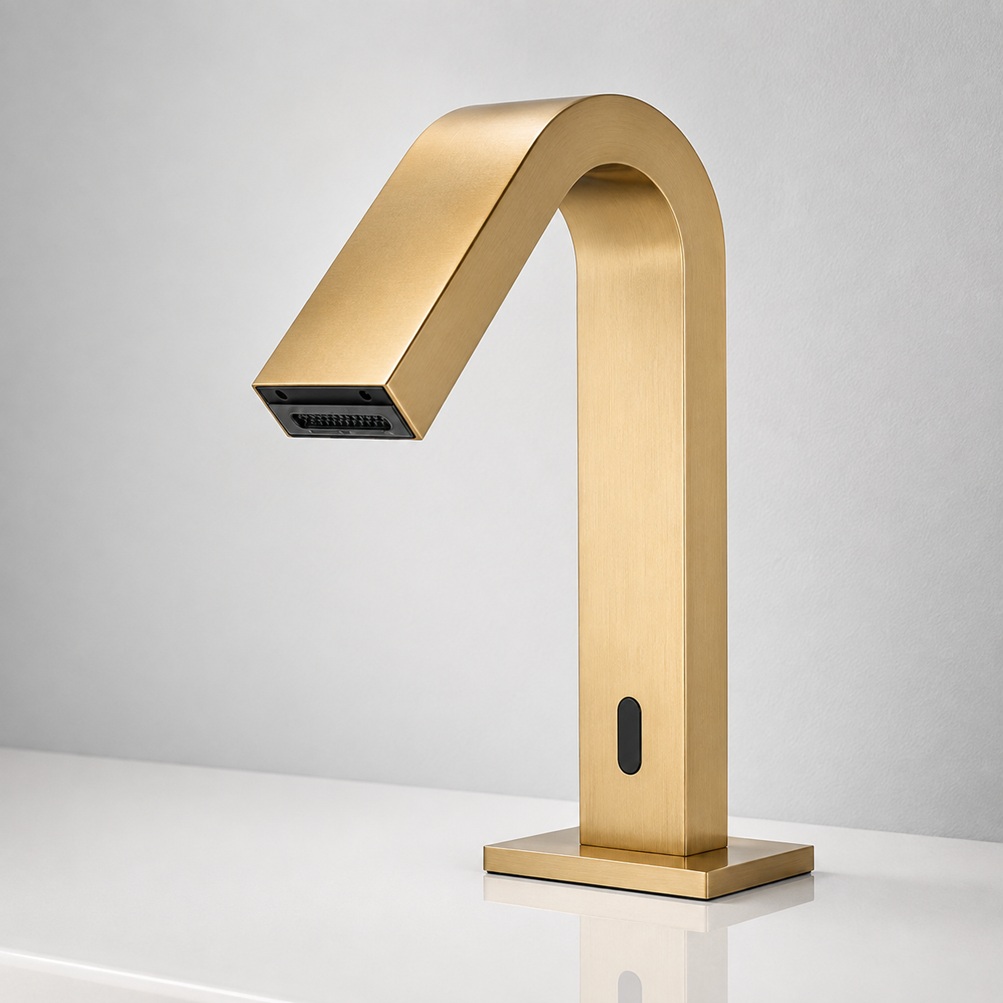
Fontana d’Azur Brushed Gold Touchless Automatic Sensor Hands Free Faucet
Fontana’s technical documentation specifies a maximum flow of 2.0 L/min at 0.3 MPa—approximately the 0.5 GPM commercial class—together with automatic sensing adjustment, fast activation and automatic shutoff.
This is a practical example of the balanced-flow approach: rather than pushing output as low as possible, the specification prioritizes efficient water delivery while maintaining a fuller washing stream.
Balanced commercial output with premium architectural presentation.
Confirm exact project flow configuration against current submittal documentation.
Best fit: Luxury hotels, corporate offices, premium public restrooms and high-traffic commercial interiors.
Review Fontana d’Azur →Sloan SF-2150 Standard Commercial Sensor Faucet
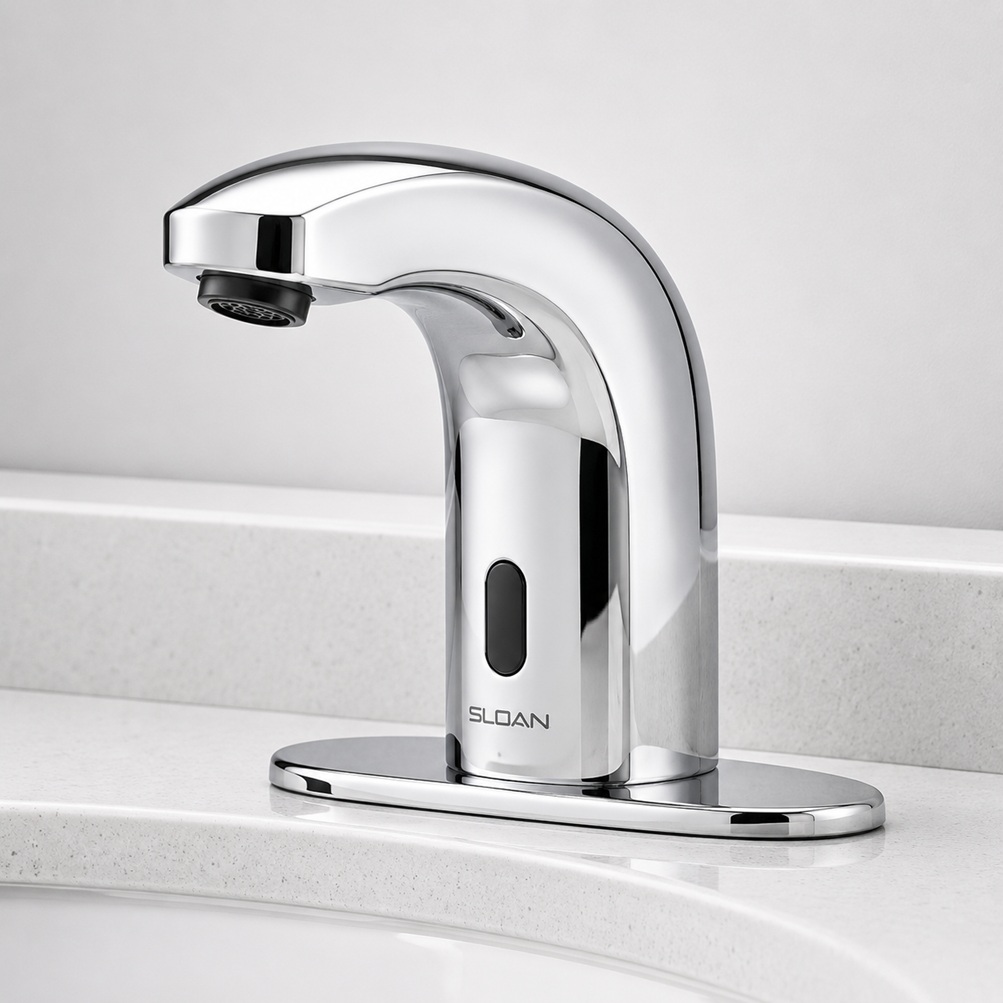
Sloan SF-2150 Standard Battery-Powered Commercial Sensor Faucet
The SF-2150 is particularly valuable for this comparison because Sloan offers the same commercial platform in both 0.35 and 0.5 GPM configurations. The 0.35 GPM version uses a multi-laminar spray head, while the platform includes adjustable infrared sensing and a filtered solenoid valve.
This allows owners to change the water-delivery strategy without completely changing faucet architecture—a useful advantage for campus standards and portfolio retrofits.
0.35 and 0.5 GPM options permit direct project-by-project optimization.
Ultra-low-flow user acceptance should be evaluated with the actual basin.
Best fit: Education, government, healthcare and cost-sensitive commercial programs.
Review Sloan SF-2150 →Image standard: Both product images are manufacturer-linked, uncropped, displayed at 500+ px on desktop and clickable to their corresponding product pages.
Why Spray Pattern Matters as Much as GPM
A well-engineered 0.35 GPM multi-laminar spray can feel more useful than a poorly directed higher-flow stream. The outlet determines how water is distributed across the hands, while basin geometry determines whether that stream washes cleanly or splashes onto the counter.
For this reason, architects should review flow rate + outlet type + basin geometry as one system. Ultra-low-flow fixtures deserve a physical mock-up on major projects rather than selection from a schedule alone.
Where 0.35 GPM Makes the Strongest Case
The conservation difference becomes meaningful at scale. Airports, stadiums, universities and large office portfolios can accumulate millions of handwashing cycles. Reducing each activation from a 0.5 GPM-equivalent stream to 0.35 GPM can materially lower annual water consumption when runtime remains equal.
Sloan introduced expanded 0.35 GPM BASYS options in 2025 specifically around commercial water-efficiency objectives, while emphasizing that the lower-flow spray heads maintain the same faucet platform and can support retrofit upgrades.
Our Recommendation
| Choose 0.35 GPM when… | Water reduction is a primary objective, fixture counts are high, and outlet/basin performance has been validated. |
| Choose 0.5 GPM when… | You want a conservative commercial-efficiency baseline with a fuller perceived stream. |
| Do not decide from GPM alone when… | The basin is shallow, highly reflective, unusually shaped or especially splash-sensitive. |
Commercial Low-Flow Brands Worth Researching
0.35 vs. 0.5 GPM FAQ
Does 0.35 GPM save 30% versus 0.5 GPM?
Yes, when both faucets operate for the same amount of time.
Is 0.35 GPM too low for handwashing?
Not necessarily. Outlet design and spray distribution strongly influence perceived performance.
Why use multi-laminar spray?
Multiple controlled streams can improve coverage and reduce splash at very low flow rates.
Does 0.5 GPM qualify for WaterSense in public restrooms?
No. Public lavatory faucets are currently outside EPA’s WaterSense-labeling category.
Should airports use 0.35 GPM?
It deserves strong consideration because high fixture counts magnify water savings, provided user performance is validated.
Can an existing faucet be converted to lower flow?
Some commercial platforms support replacement spray heads or flow-control components; verify manufacturer compatibility.
Engineering References
U.S. EPA — Bathroom Faucet Efficiency
Current federal guidance for public-lavatory faucet efficiency.
U.S. EPA — Ineligible WaterSense Products
Clarifies public-lavatory faucet labeling and efficiency recommendations.
American Society of Plumbing Engineers
Professional plumbing-engineering resources for commercial system specification.
U.S. Green Building Council — LEED
Green-building framework relevant to indoor potable-water reduction strategies.
Specify the Lowest Flow That Still Performs Well
For very large high-traffic portfolios, 0.35 GPM deserves serious consideration because its conservation advantage compounds across thousands of daily uses. For projects prioritizing a fuller handwashing stream and broad user acceptance, the 0.5 GPM class remains an excellent efficiency baseline. The Fontana d’Azur Brushed Gold Touchless Automatic Sensor Faucet represents the balanced commercial approach, while Sloan’s SF-2150 demonstrates how one faucet platform can accommodate both low-flow strategies.
Review Fontana d’Azur Touchless Faucet →Independent editorial disclosure: CommercialTouchlessFaucetReviews.com provides technical editorial analysis based on published manufacturer information. Flow-performance conclusions are not laboratory testing. Verify current flow-control components, pressure conditions, codes and exact manufacturer specifications before procurement.